Print This Page
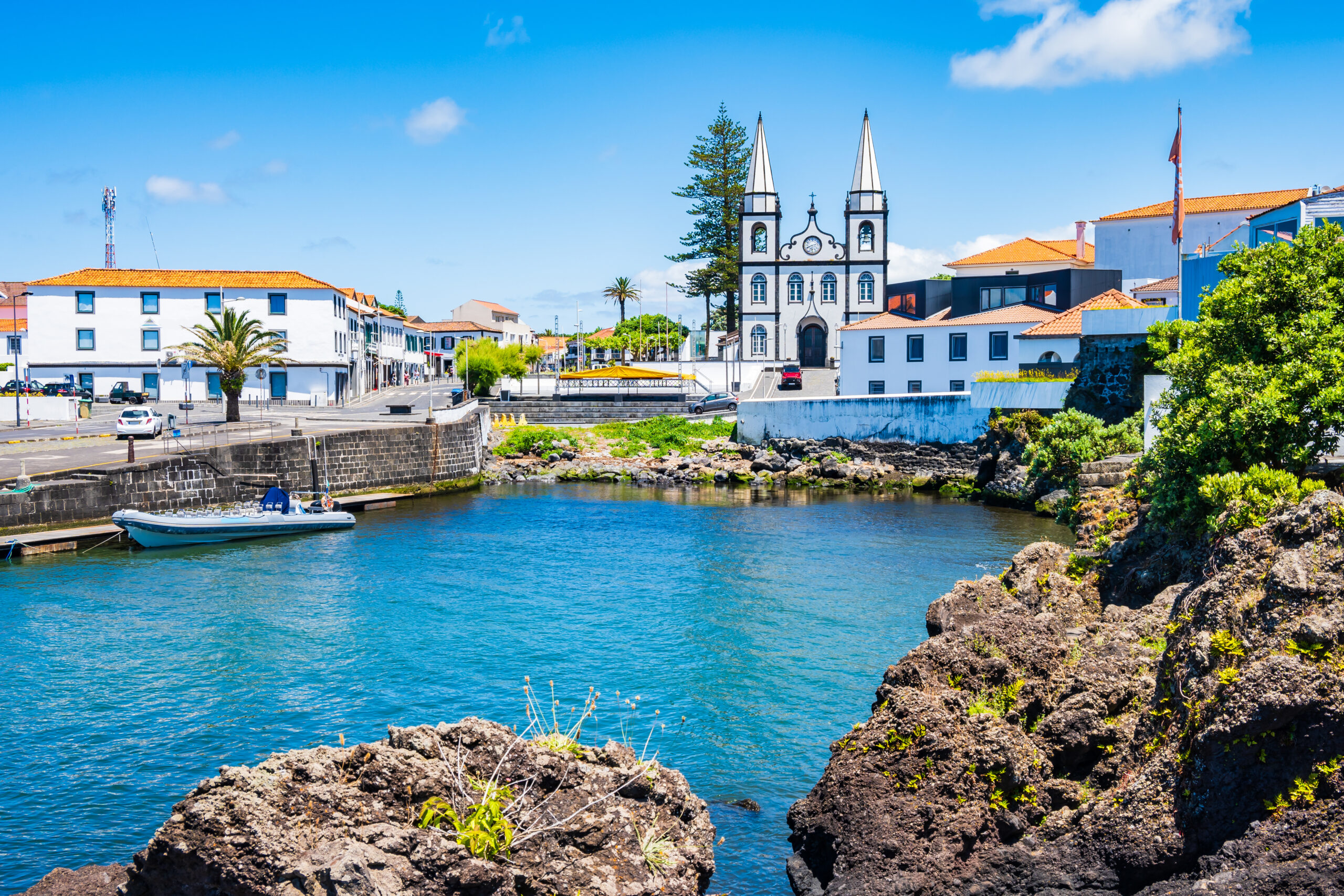
Madalena
The trading and communications centre of the island Its position facing Faial and the town of Horta has made it, since line initial settlement period, the port that ensures links with the neighbouring island. Even nowadays picturesque coasting vessels connect the two fishing ports. Typical town. Fishing port. Daily connections with Horta by motor-boat, Facing the town lie the curious islets "Deitado" (Lying Down) and "Em pe" (Standing), where a birds have their nests.
At Areia Larga, a traditional summer resort you may enjoy the sight of some of the oldest manor houses of the "verdelho" cycle.
Places to visit: Church of Santa Maria Madalena; the Town Hall and the wine Museum set up in the former Carmelite convent.
At Areia Larga a traditional summer resort, one may find the largest cannery in the Azores and a co-operative wine cellar.
Bandeiras
A village connected with the "wine cycle" and the prosperity it brought to the island in the 18th and 19th centuries. Resorts at Cais do Mourato and Cachorro. At the latter place there is an old chapel, the destination of tin most traditional penitential pilgrimage of the people of the Azores. The locality called Cabeço Chao has a outstanding micro-climate in the mild weather that is enjoyed all over the island.
Here, too, is one of the most characteristic rural chapels, in which the artistic wood carvings of the altar are outstanding.
Place to visit: Church of Nossa Senhora da Boa Nova. Construction dating from the middle of the l9th century. Excellent facade made of good dressed stores.
Santa Luzia
Characteristic village. Close to the small, picturesque sea-side villages of Lajido and Cabrito. Have a look at the place called Ribeira Nova - a recently abandoned small village - where you can still enjoy tin sight of some basaltic constructions with original characteristics.
Places to visit: Scrimshaw shop of the artist Fatima Madruga and Church of Santa Luzla.
Santo Antonio
Named after the great Portuguese-born saint, the parish includes the small villages of Santana and Sao Vicente, with their chapels.
Church of Santo Antonio. Small place of worship, founded towards the end of the 17th century. Unlike most churches in Pico, it has only one tower.
The place called Furna, where arriving birds perch, displays a curious combination of volcanic forces and the fury of the ocean waves.
Sao Roque do Pico
Old town, with characteristic and interesting houses, Commercial port at Cais do Pico, connected with the whaling industry and the site of the only whaling factory in the archipelago.
Places to visit: Church of Sao Roque and Convent and Church of Sao Pedro de Alcantara.
Prainha do Norte
The second settlement founded on the northern coast of the island.
Place to visit: Church of Nossa Senhora da Ajuda. Large edifice, with an interesting facade (18th c).
Typical old wine cellars, connected with the centuries-old production of verdelho wine, mainly in the area of Canas bay. Close to a large misterio (mystery), a lava bed covered with trees, resulting from an eruption in 1572 and, in the woods overlooking it small but bucolic Lake Caiado.
Santo Amaro
Small village stretching from the small beaching-place for poets to the heights of Terra Alta. Main shipbuilding yard in the Azores, using old manual techniques.
Place to visit: Church of Santo Amaro.
Ribeirinha
The youngest parish in Pico (1980). Places to visit: Church of Santo Antao and Sitio da Baixa, a characteristic example of the summer sea-side resorts preferred by the inhabitants of Pico.
Piedade
Village situated at the eastern extremity of the island. Interesting vistas of the sea and the inland areas. Lovely, curious park of the Forestry Services.
Place to visit: Church of Nosse Senhora da Piedade.
Calheta de Nesquim
Important old port. Typical base for whale hunting, with tug boats and elegant canoes. Place where the first base for hunting the sperm whale was set up in 1876.
Place to visit: Church of Sao Sebastiao.
Ribeiras
One of the first settlements in the island. Fishing port with long traditions and experienced sailors. Worthy of visits are the churches of Santa Cruz and Santa Barbara (which replace a 17th c. place of worship), as examples of the rural-style religious art of the Azores.
Lajes do Pico
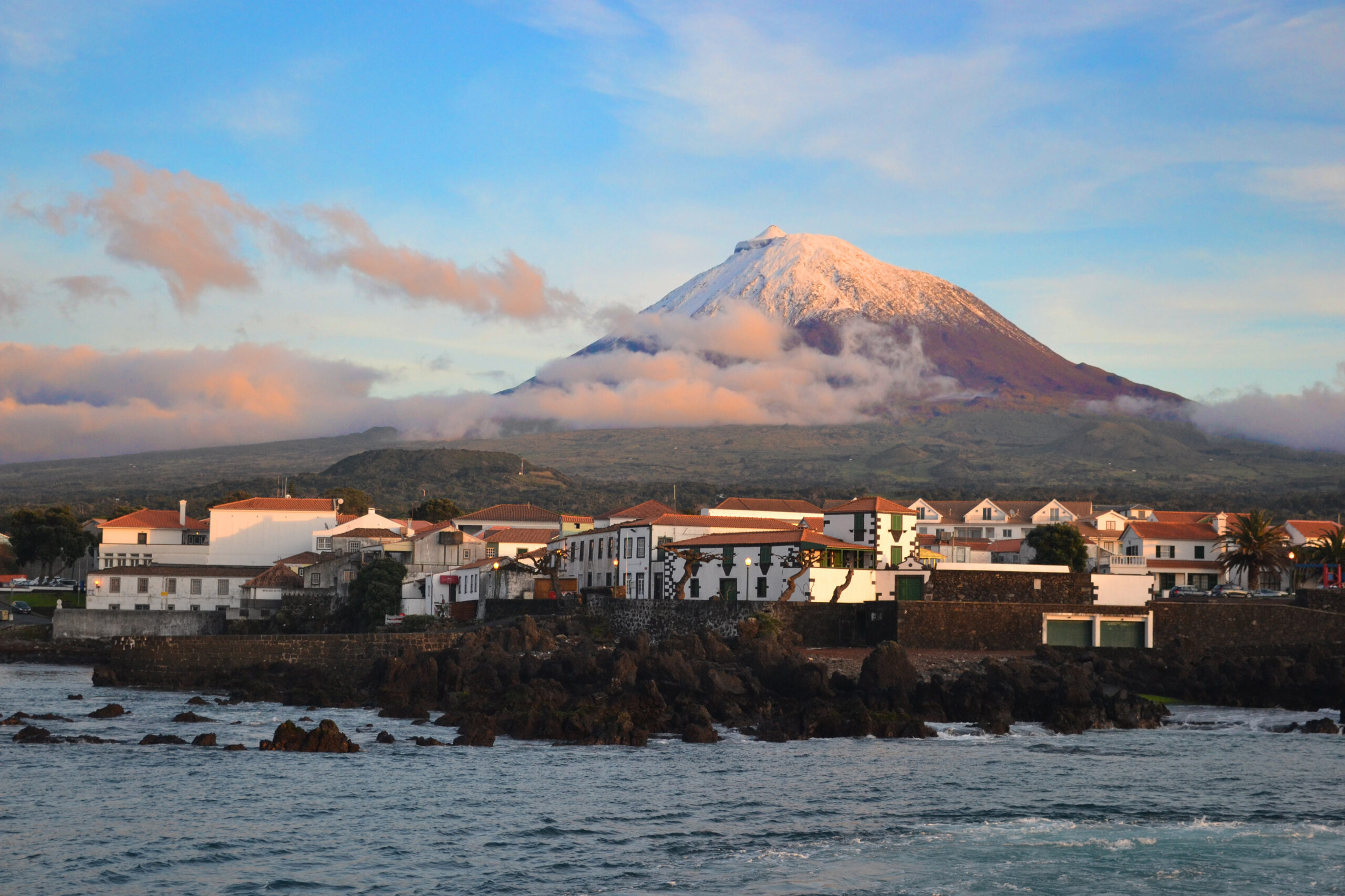
The first settlement on the island. Important fishing and commercial port. Whale hunting centre with a centuries-old tradition. Old houses, with dressed stones and balconies running the length of the facade, revealing past prosperity. Picturesque views of the port, with its houses by the sea, and of the volcano of Pico. Curious plant for making dairy products.
Place to visit: Church of Nossa Senhora da Conceicao; Chapel of Sao Pedro and Whalers' Museurn. Set up in the former Boat-House. Whaling-boat with its equipment. Products of the whaling industry. Important collection of scrimshaw made from the teeth, bones and ivory of the sperm whale. At the place called Silveira, the only source of mineral water in the island.
Sao Joao.
Set between two misterios, destroyed by the volcanic eruption of 1718 which buried its original church, it has a small port, one of the first that was used as a whale hunting base. Its inhabitants, whose men work on land and or the sea like most of the people of Pico, have won fame for making the savoury cheese that bears the name of the parish.
Place to visit: Church of Sao Joao Baptista.
Sao Caetano (or Prainha do Sul)
It is still called Prainha do Galeao (literally, Little Beach of the Galleon) because of the ship built there by Garcia Gonçalves Madruga in the 16th c. to pay debts owed to King João III. Magnificent bay. Belonging to the parish is the locality called Terra do Pao, with a small church dedicated to St Margaret.
Place to visit: Church of Sao Caetano.
Sao Mateus
One of line oldest villages in the island. Its foundation dates back to 1482. An alternative port for connections with Faial and one of the last existing bases for whale hunting. Land of lace-makers, who produce excellent crochet work.
Place to visit: Church of Sao Mateus.
Candelaria.
Picturesque village in an area or vineyards and orchards. Birthplace of the late cardinal, Jose da Costa Nunes. Place to visit: Church of Nossa Senhora das Candeias.
Criacao Velha.
Of advanced age, as its very name indicates (Criacao Velha means Old Creaton), it is still the true home of verdelho wine, with golden grapes that ripen on large beds of lava at the place called Lagido. Place to visit: Church of Nossa Senhora das Dores.
The Island of the whaling men. Whale, whale!
For over a century, the shout of "whale in sight!" has echoed in the streets of the ports of Pico, preceded by the explosion of a warning rocket set off by the "watchman" stationed on a height with a broad view of the ocean, The canoes then set out; formerly by oars or sails, more recently they were towed by motor-boats. After that, what takes place is the struggle between man and monster, waged with skill, persistence, strength and courage. When the harpoon strikes home, the furious race begins, with the kilometre-long rope, carefully rolled up in the wooden tub, hissing with the effort to resist the impetus of the sperm whale. Then the great mammal becomes tired out... it is killed and tugged to the "factory" where the oil and spermaceti, used in making perfume, are extracted. The highly coveted teeth of the cachalot are divided among the crew of the canoe. This marks the end of a deed made up of risk and heroism, one that is repeated every time the canoes go out after a sperm whale. The frequency with which this takes place is declining, however, because the whaling men are becoming fewer and fewer in view of the difficulty in selling the oil and spermaceti and the harsh effort required by the hunt. Of the five factories that once existed in the region. only one, situated at Cais do Pico, is now left but not working due to the recent prohibition of whale catching.
The Azores and the whalers
It was in the middle of the 18th century that the first American whalers appeared in the waters of the archipelagos. Soon they came every year, in larger and larger numbers, to hunt the sperm whale, unload the barrels of oil, repair the ships, refresh the crews and recruit harpooners and rowers from among the inhabitants of the islands, mainly Pico, Faial, Flores, Graciosa and Corvo.
This presence of the whalers, which continued until the end of the 19th century, when oil extracted from petroleum replaced whale oil in many uses, led the Azoreans to the far corners of the globe. Besides the groups that look root in the whaling ports of New Bedford and Nantucket, on line east coast of the United States, considerable numbers of Azoreans settled, right in the first decades of the 1800s, on the coast of California, in Hawaii and in other Pacific islands, thus giving rise to the present emigrant communities established in America.
The Azorean canoes
It was in the middle of the l9th century, with canoes imported from America, that the first experiments at whale hunting were carried out from the ports of Pico. A contribution to this activity was made in the initial phase by the Dabneys, the American family settled in Faial, then an important trading emporium connected with shipping.
The first canoe built in the Azores, at Lajes do Pico, was launched in 1894. Ever since, whaling canoes have been produced in the archipelago, maintaining the original model although slightly more elongated. Everything in them is prepared for swiftly, almost silently, sticking the harpoon into the cachalot, resisting the struggle it puts up, surviving and winning. The equipment is minimal and rudimentary but has been tested over the centuries.
The oars, the harpoons and lances, the mallet (to straighten out the lance, if necessary), the large vessel (to bail out the water that may enter the canoe), the wooden tubs for the ropes, the signal-flags, the lantern for signalling, the compass - everything has a part to play, occupies the least possible space and has its own place.
Present in museums in Europe and America, the whaling canoe of the Azores is surprisingly attractive because of its elegant and functional lines, its lightness and robustness. It recalls centuries of maritime history that are still kept alive in the Azores and it has its heart and main centre of activity in Pico.
Copyright Pierre LaVelly Sousa Lima