Discover Azores | Azores.com

           Login | Register 


Password? | Username?

Close

*
*
*
*
*

Fields marked with an asterisk (*) are required.

Close
| Share : |
English PortuguêsDeutsch - Bitte beachten Sie, dass es keine deutscEspañol - Atención, los módulos de travel no están

5_disc

Get our Quarterly Newsletter
Lastest news and specials
Reset

     Azores Travel & Tours
     Online since 1996

    AirAirAir FerryFerryFerry HotelHotelHotel CarCarCar ToursToursTours FunFunFun FoodFoodFood ContactsContactsContacts

Discover

AzoresAzoresAzores
Santa MariaSanta MariaSanta Maria
São MiguelSão MiguelSão Miguel
TerceiraTerceiraTerceira
GraciosaGraciosaGraciosa
São JorgeSão JorgeSão Jorge
PicoPicoPico
FaialFaialFaial
FloresFloresFlores
CorvoCorvoCorvo
Real EstateReal EstateReal Estate
Maps & POISMaps & POISMaps & POIS

Restaurants

Azores Restaurants

Like us!

FacebookNew

Events Calendar

<< May 2013 >> 
 Mo  Tu  We  Th  Fr  Sa  Su 
    1  2  3  4  5
  6  7  8  9101112
13141516171819
20212223242526
2728293031  
You are here : Santa Maria

  • About
  • Activities
  • Events
  • Gastronomy
  • Handicraft
  • Local Products

About

Poster Image

Download Video: WebM, HTML5 Video Player by VideoJS

  • The Island

  • History

  • Geography

  • Economy

  • Points of Interest

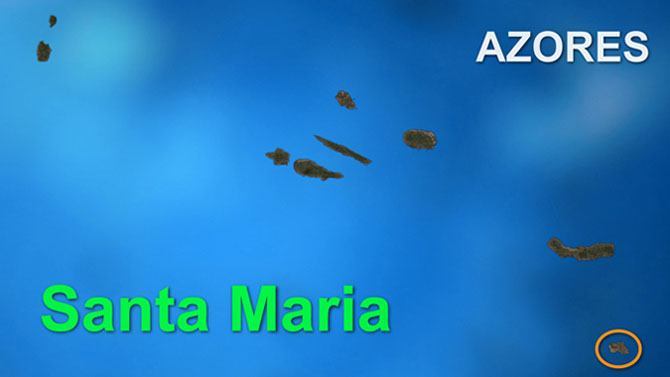
Map of Santa Maria island
Coordinates: 36° 58' 14" N, 25° 6' 18" W
 
Santa Maria is about 55 miles from S. Miguel island (30 minutes by plane). It is the third smallest island of the Azores, known as the yellow island. The surface area is approximately of 38 sq miles (97 km2). The island has about 5500 inhabitants. The municipal seat is located in the parish of "Vila do Porto".
 
The green plaid of the fields; Ripe, yellow crops; The dots of white-washed houses with lace-like chimneys; The black of the artistically chiseled basalt in the facades of churches; The rainbow color of the flowers; The dark ochre of the fertile earth; The gold of the sandy beaches; The palette of hues like a living water-color that is Santa Maria; The joy of folk festivities; The delicacies of a traditional cuisine. All these make Santa Maria stand out as a unique island in the Azores.
Pin It
Tweet
The first records of a group of islands in the Atlantic (aside from the legends of Atlantis) came from the voyages of Portuguese sailors during the reigns of King Dinis (1279–1325) and his successor King Afonso IV (1325–1357). These were unsubstantiated accounts and unofficial until 1427 when pilot Diogo de Silves found the island of Santa Maria (at that time referred to on nautical charts as "Ilha dos Lobos" or "Ilha do Ovo") during his journey to Madeira. Myth tells that on the day of the islands discovery, that Goncalo Velho Cabral and his crew were celebrating mass, on the feast day of the Virgin Mary, when one of the lookouts spotted the distant island, declaring "Santa Maria". The name would become permanently associated to the island. Santa Maria was discovered in 1432 by Goncalo Velho Cabral (rather than the pilot Silves) since discoveries were not "recognized officially" until declared so by the Portuguese crown. The year previous, Goncalo Velho Cabral had discovered the small rock outcropping of Formigas northeast of Santa Maria.
 
With the support of Queen Isabel, the same Goncalo Velho was also nominated to be the first Captain-major of the island of Santa Maria and later Sao Miguel, where he arrived in 1439 with colonists, bringing their families and some cattle. By 1460, the chronicler Diogo Gomes de Sintra identified the island as "Ilha de Goncalo Velho". Colonization progressed between 1443 and 1447, principally from the Portuguese Alentejo and Algarve, who populated the northern coast along the Baia dos Anjos ("Angels Bay") and later in the area of Vila do Porto (in the southwest coast). Vila do Porto would become the larger municipality by 1470. By the end of the 16th century, Santa Maria was divided into three parishes: Nossa Senhora da Assuncao (Vila do Porto), Santa Barbara and Santo Espirito.
 
Similar to other islands of the archipelago, Santa Maria was a victim of repeated attacks by privateers and pirates. In 1480, a Castilian carrack with 40 men disembarked in the port of Vila do Porto, were they were confronted by residents under the command of the Captain-Major Joao Soares de Albergaria, who took to hurl rocks from the cliffs above Calhau da Roupa. Joao Soares was eventually captured by the Spaniards, who took him in irons as a prisoner to Castillo. For this reason, the population was very hostile to the traveling Christopher Columbus who disembarked in the Baia dos Anjos in February 1493, returning from his famous "discovery" of the New World. Several of his crew members were captured, and complex negotiations were undertaken to liberate them. A mass was celebrated by Columbus and his party in the old chapel before he returned to Spain. Although relatively far from the routes used by ships traveling to India, the island was repeatedly attacked by French pirates (1553), by French troops (1576), by the English (1589) and by the Moors (1616 and 1675). By the 17th Century, a series of fortifications were constructed along the coast to defend the population from these attacks, including the Fort de Sao Bras (Vila do Porto) and the (ruined) Fort of Sao Joao Baptista (Praia Formosa).
 
When the 1580 crisis of succession ushered in the Iberian Union in Portugal, the island initially supported D. Antonio I of Portugal, but with pressure from Philipe I in the Azores, Antonio declined even to disembark in Santa Maria. During this period, the island came to depend on the Governor General of the Azores. After the Restoration (1640), the news was greeted with celebrations and excesses by the Captain-Major Bras de Sousa.
 
During the Portuguese Civil War (1828–1834) the citizens supported the rights of Maria II to the throne of Portugal, which differed immensely from the Governor General of the Azores (on the island of São Miguel) who supported Miguel. The Captain-major even attempted to raise arms from Terceira, insofar as sending a carrack to collect the weapons. In the interim, the São Miguel administration changed sides in the conflict. By the following year, several Marienses joined the expeditionary force disembarking on the continent along Arnosa de Pampelido beach (near Mindelo, Vila do Conde) during one of the crucial battles of the Civil War.
Pin It
Tweet
Santa Maria is located in the southeast corner of the Azores archipelago, 100km south of São Miguel, and 600km from the island of Flores (the western most island in the archipelago). The island is 97,4km² , with a ovular shape. Geologically, it is the oldest island in the archipelago, with formations that are 8.12 million years old. Due to its age, and no historical evidence of volcanism, the geography of the island tends to be more mature and includes larger deposits of sediments then can be found on the other islands of the archipelago. Similarly, marine fossils have been discovered on the island (in Prainha and Lagoinhas) that date back 117-130 million years (the Pleistocene epoch), and others (in Ponta do Castelo) dating back 5 millions of years (to the end of Mioceno and beginning of the Paleocene. These deposits are evidence of an older island environment associated with both volcanic and sedimentary development. Generally, Santa Maria is known for the lack of volcanism during period of human intervention, although seismic events are common due to its proximity to the Glória Fault, a offshoot of the Azores-Gibraltar Transform Fault.
 
Volcanic in origin, Santa Maria geology is characterized by substrata of basalt deformed by a series of fractures in a northwest-southeast orientation. This is interlaced with lode and deposits of silicate material. In addition, there are several calcium encrusted fossil deposits associated with marine formations, during a period of formation associated with underwater activity. The presence of these deposits, unique in the Azores, gave rise to the lime (calcium oxide) industry during the 19th Century.
Pin It
Tweet
The island's economy passed through much of the cyclical evolution associated with the Azores. Initially, the economy was based on the production of wheat and wood, until the 16th century, evolving slowly to a subsistence economy based on cereal crops. This was also a period of pottery production and export of the fine red clay to artisans on São Miguel (for the production of the same).
 
Generally isolated from the traffic between the New World and Europe the island depended heavily on agriculture until the 20th century, when US forces established the Airport in Ginjal. It became an international link after 1944, taking on a central position in trans-Atlantic air traffic during the mid-20th century. The island became dependent, almost absolutely, on the airport: first, during the phase of construction (when Marienses were involved in the construction or support) and later when air traffic control in the north Atlantic corridor was based in Santa Maria (FIR Oceanica de Santa Maria). For many decades, the airport at Santa Maria was the gateway to and from the Azores until the construction or renovation of smaller fields on other islands. Evolutions in the aviation industry (primarily of long-range airliners) removed the importance of Santa Maria as a trans-Atlantic stop, and other airports (such as those in Lajes, Horta and Ponta Delgada), better equipped and logistically advanced diminished the importance of activities on Santa Maria. The European Space Agency (ESA) established a satellite tracking station at the end of the 20th century, rekindling the debate on the island's dependency on the aviation sector.
 
In comparison with the other islands, the raising of cattle and milk production never attained the same level of dependency. Regardless, agriculture is still the predominant activity in the municipality, occupying 47.6% of the land. This activity is usually confined to small ventures, involving forging plants, small pastures and permanent holdings. Secondary industries are dominated by civil construction, sawmills, tile and block factories, artisan/handicraft producers and fishing. There are several commercial species of fish in the waters around Santa Maria, such as Sheepshead, Vejas, Red Snapper, Grouper, Wrasse, Mackarel, Achovies, Needlefish and Frigate tuna.
 
As with the rest of the Azores, tourism makes-up an important tertiary sector, associated with nautical activities such as sailing, windsurfing, water-skiing, sport fishing (Tuna, Swordfish, and Grouper) and scuba-diving, beach activities, pedestrian hiking and, for some, rabbit hunting. São Lourenço, Praia Formosa, Maia and Anjos are known as summer tourist centers, attracting visitors to the beaches, natural pools, summer cottages/homes and festivals.
Pin It
Tweet
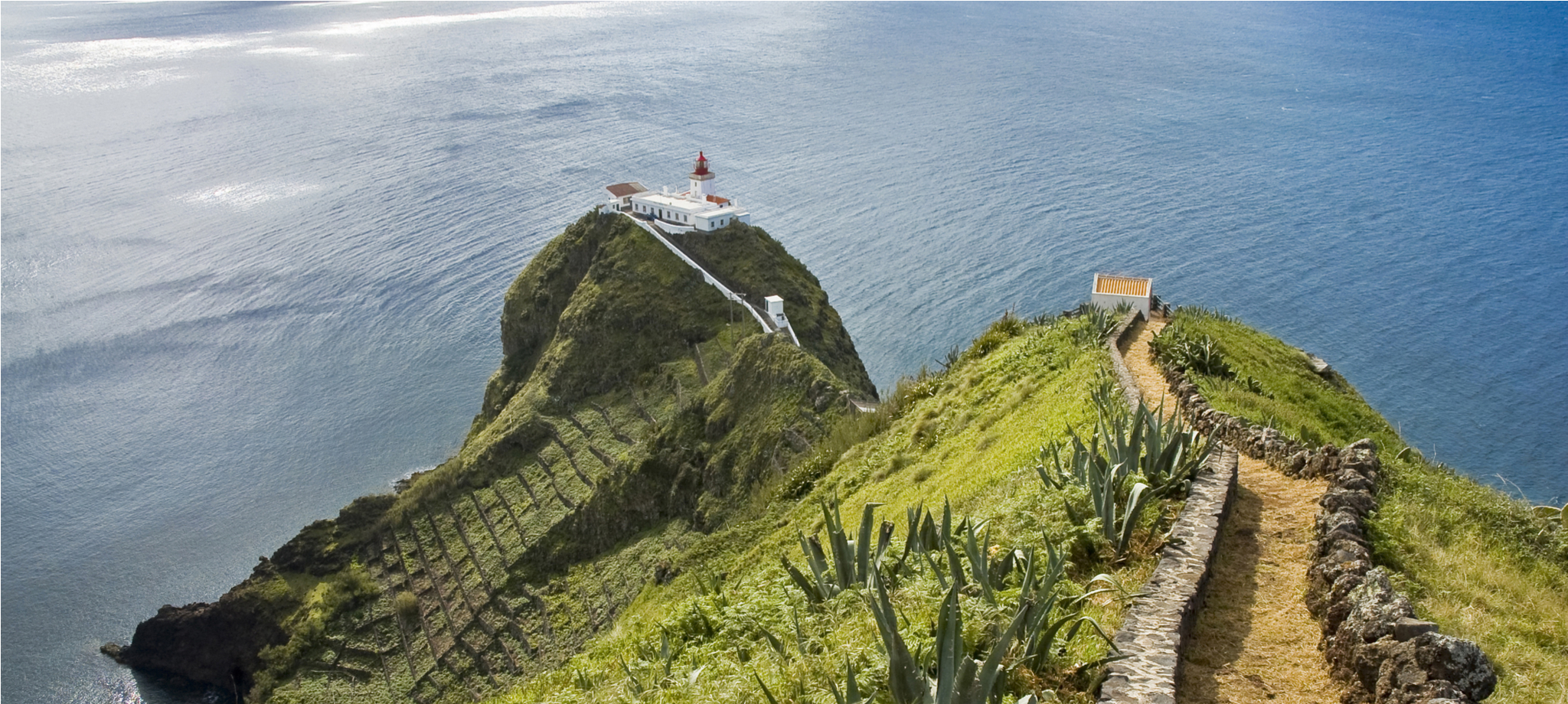
Maia and S.Lourenco Bay - Two of the most beautiful bays in the archipelago, with its cliff side vineyards. Both have bathing facilities.
 
Anjos - The village is historically very significant as the first landfall of Christopher Columbus on his return from Americas.
 
Santo Espirito - A pretty village surrounded by pastures, with a beautiful parish church.
 
Praia Formosa - Yellow sandy beach, one of the best in Azores
 
Some viewpoints - "Fontinhas", "Lagoinhas", "Espigao" and "Picos" and of course "Pico Alto" with 1926 feet (587 m).
Pin It
Tweet
Previous
Next

Activities

Market browsing

Browsing and shopping local outdoor markets is a local pastime

#

Hiking

Lagoa do Congro - The Azores have numerous hiking trails

#

Yoga in the park

Parque Urbano (Ponta Delgada) - Yoga hour.

#

Wind Sports

From paragliding to sailing the Azores is ideal for wind sports

#

Bike riding

The Azores are a bike riding friendly place

#

Hiking and Walking

Hiking and Walking are a local pastime

#

Whale and Dolphin Watching

Cetaceans can be observed in many island of the Azores. You may swim among dolphins if you feel adventurous

#

Bird Watching

The Azores is popular with bird watchers

#
http://www.azores.com/components/com_gk2_photoslide/images/thumbm/534270eunice516.jpg
http://www.azores.com/components/com_gk2_photoslide/images/thumbm/331164hiking516.jpg
http://www.azores.com/components/com_gk2_photoslide/images/thumbm/166721yoga516.jpg
http://www.azores.com/components/com_gk2_photoslide/images/thumbm/405149parapente516.jpg
http://www.azores.com/components/com_gk2_photoslide/images/thumbm/906192biking516.jpg
http://www.azores.com/components/com_gk2_photoslide/images/thumbm/760910walkingurbano516.jpg
http://www.azores.com/components/com_gk2_photoslide/images/thumbm/639887whale516.jpg
http://www.azores.com/components/com_gk2_photoslide/images/thumbm/216558bird516.jpg
News Image

...

News Image

...

News Image

...

News Image

...

News Image

...

News Image

...

News Image

...

News Image

...

Santa Maria is best known for its white-sand beaches contrasting the dark-sand volcanic origin beaches found on the remaining islands of the Azores. The warm weather and beaches make Santa Maria’s activities revolve around water sports and activities. Praia Formosa and Sao Lourenço are the two best beaches due to their fine-grain sand and extension. These beaches are excellent for windsurfing, surfing, water-skiing and sailing. Skin and scuba diving can be better appreciated in Prainha and Xareus Cave.

Sportsfishing is also a popular activity where one can catch of bluefish bream, amberjack, conger eels, stone bass, grouper, mackerel, snapper and anchovies and many others.In addition to its great beaches Santa Maria’s coastline features natural swimming holes such as Sao Lourenço, Maia and Anjos swimming spots.

Hiking and trekking can also be done in the many pedestrian walking trails and hiking circuits featured all over the island. The hiking circuits allow the user to experience a range of diverse eco-systems and protected areas of the island that are not easily accessible to most tourists. Several natural landscapes have been preserved or designated points of natural interest by the Regional Government in order to foster conservation and support endemic species of flora and fauna, as well as provide communal forms of recreation and nature interpretation.

Santa Maria’s cultural heritage consists of many public buildings, churches and other structures such as military constructions that have been remodeled and preserved for their important historic and cultural significance. Since there is no historical volcanism and therefore fewer incidences of earthquakes, Santa Maria, which was the first island to be colonized, features older buildings and structures than any other island.

Events

IRC Rally Azores

S. Miguel island is part of the IRC car rally circuit happening annually

#

Senhor Santo Cristo

Arguably the biggest religious festivities in Azores, happens annually on the fifth weekend after Easter

#

Bull Fights (bull on rope)

People waiting for bull - Typical of Terceira island it happens in many places throughout the island from May to September

#

Limas water battles

Ponta Delgada - Traditional battle of limas happens during carnival

#

Flower street carpets

Traditional flower carpets adorn the way for processions in religious festivities

#

Festival of lights

Convento da Esperanca - One of the highlights of religious festivals are the amazing light displays

#

Street Vendors

Selling the typical tremoco (lupinus) and candy

/__404__

Carousel

Always a hit with young and old carousels are part of the festivities fabric

#
News Image

...

News Image

...

News Image

...

News Image

...

News Image

...

News Image

...

News Image

...

News Image

...

As in all the other Azorean islands, one of the most popular events is the Holy Spirit Festivals (Divino Espirito Santo celebration). These festivities date back to the original settlements and were introduced by the Order of Christ and the Franciscan monks in the 14th century. The festivals include a religious ceremony, starting with the "crowning" of one or more children with a silver-plated crown adorned with the symbols of the Holy Spirit, and culminate with a grand feast on seventh sunday following Whitsun. On the occasion of these feasts, a traditional soup of bread soaked in a meat broth is distributed freely at the "Imperios" across the island.

Vila do Porto holds the festival of “Senhor Santo Cristo dos Milagres” and on August 15th the parish celebrates the “Nossa Senhora da Assuncao” (Our Lady of the Assumption) festivities.

“Mare de Agosto”, celebrated in Praia Formosa in the last week of August is the biggest music festival in the Azores. It attracts large crowds of locals and visitors and features national and international world music acts.

Gastronomy

Sopas Feasts

Traditional Holy Ghost Sopas from Santa Maria

#

Dill & Mint

Dill is specific of Santa Maria. Mint is used in all Sopas

#

Lining up for Sopas

Long lines demonstrate the popularity of Sopas feasts

#

Sopa Bowl

Sopas a tradition shared in every Azorean community

#

Biscoitos (cookies)

Making biscoitos de orelha

#

Sopa plate

The famous sopa plate

#
http://www.azores.com/components/com_gk2_photoslide/images/thumbm/887538smasopas516.jpg
http://www.azores.com/components/com_gk2_photoslide/images/thumbm/310610endrohortela516.jpg
http://www.azores.com/components/com_gk2_photoslide/images/thumbm/583296filasopas516.jpg
http://www.azores.com/components/com_gk2_photoslide/images/thumbm/213040panelasopas516.jpg
http://www.azores.com/components/com_gk2_photoslide/images/thumbm/435103bisoitos516.jpg
http://www.azores.com/components/com_gk2_photoslide/images/thumbm/698132prato516.jpg
News Image

...

News Image

...

News Image

...

News Image

...

News Image

...

News Image

...

Santa Maria gastronomy is rich and diverse. The “Sopa de Peixe” (a fish soup), and “Caldeirada de Peixe” (a mixture of fish or seafood in broth and/or bread); Sweet desserts such as “Suspiros” (meringues), “Melindres” (honey cakes) “Sopa de Nabos” (turnip soup), “Bolo de Panela” (cake), “Caçoila” (a thick meat stew in traditional ceramic pot), “Molho de Figado” (a liver stew/sauce), “Biscoitos Encanelados”, “Tigeladas” (a pudding), "Biscoitos de Orelha”, ”Biscoitos Brancos”, “Biscoitos de Aguardente” and “Cavacas"  (sugar-coated biscuits) are features in the local cuisine.

For those interested in fishing for local consumption there are plenty of  bluefish bream, amberjack, conger eels, stone bass, grouper, mackerel, snapper and anchovies.

Santa Maria’s wine comes from the São Lourenco foothills. Wines and liquors include “Vinho Abafadinho” and “Vinho Abafado” (both fortified wine liquors), “Licor de Amora"  (blackberry liquor), " Licor de Leite"  (milk liquor) and " Aguardente"  (Portuguese brandy).

Handicraft

Clay work

Clay and Wicker are art forms that span centuries in Azores

#

Bonecos

Bonecos are figurines made of straw and cloth

#

Wicker work

Wicker is used for many uses. More traditional for basket weave.

#

Clay artisan

Azores ceramics industry is world renowned

#

Mantle weaving

Santa Maria mantle weaving

#
http://www.azores.com/components/com_gk2_photoslide/images/thumbm/751184barro516.jpg
http://www.azores.com/components/com_gk2_photoslide/images/thumbm/608767bonecos516.jpg
http://www.azores.com/components/com_gk2_photoslide/images/thumbm/990218cestos516.jpg
http://www.azores.com/components/com_gk2_photoslide/images/thumbm/679513barro516.jpg
http://www.azores.com/components/com_gk2_photoslide/images/thumbm/801303ter516.jpg
News Image

...

News Image

...

News Image

...

News Image

...

News Image

...

Due to Santa Maria’s natural resources of wool and clay, the handicraft industry consist of pottery, ceramics, wool sweaters, ornate sheets, blankets, towels and other embroidery. Homespun garments include coarse woolen jerseys, embroidered linen shirts and embroidered women's jackets. Similarly, straw hats, baskets and various other objects traditionally made from wood, fish scales, corn flask and metal are sold as souvenirs.

Local Products

Flowers

Azores flowers for all tastes

#

Pineapple of S. Miguel

Pineapples are grown in green houses and are only a product of S. Miguel

#

Meats

In Terceira, for example, cows outnumber people 2:1, thus the abundance of dairy and meat

#

Fish

Fish, abundant and varied, is an essential ingredient in the Azorean diet

#

Cheese - A Specialty

Cheese from S. Miguel, S. Jorge, Faial and Pico are world renowned

#

Vegetables

A variety of vegetables can be found in the Azoes including the local inhame (yam)

#
http://www.azores.com/components/com_gk2_photoslide/images/thumbm/699087flores516.jpg
http://www.azores.com/components/com_gk2_photoslide/images/thumbm/270478ananas516.jpg
http://www.azores.com/components/com_gk2_photoslide/images/thumbm/703127meat516.jpg
http://www.azores.com/components/com_gk2_photoslide/images/thumbm/897051fish516.jpg
http://www.azores.com/components/com_gk2_photoslide/images/thumbm/634177queijo516.jpg
http://www.azores.com/components/com_gk2_photoslide/images/thumbm/715643legumes516.jpg
News Image

...

News Image

...

News Image

...

News Image

...

News Image

...

News Image

...

Local Santa Maria product include pottery, embroidery, cheese and Alheiras.

Pin It
Tweet
  Ads - Why these?

about us | contact us | travel agents | advertise with us | privacy statement | terms and conditions | testimonials | sitemap

Copyright © 1996 - 2013 Portugal Online - All Rights Reserved | Custom Design by 1ms.pt
 Top