Discover Azores | Azores.com

           Login | Register 


Password? | Username?

Close

*
*
*
*
*

Fields marked with an asterisk (*) are required.

Close
| Share : |
English PortuguêsDeutsch - Bitte beachten Sie, dass es keine deutscEspañol - Atención, los módulos de travel no están

5_disc

Get our Quarterly Newsletter
Lastest news and specials
Reset

     Azores Travel & Tours
     Online since 1996

    AirAirAir FerryFerryFerry HotelHotelHotel CarCarCar ToursToursTours FunFunFun FoodFoodFood ContactsContactsContacts

Discover

AzoresAzoresAzores
Santa MariaSanta MariaSanta Maria
São MiguelSão MiguelSão Miguel
TerceiraTerceiraTerceira
GraciosaGraciosaGraciosa
São JorgeSão JorgeSão Jorge
PicoPicoPico
FaialFaialFaial
FloresFloresFlores
CorvoCorvoCorvo
Real EstateReal EstateReal Estate
Maps & POISMaps & POISMaps & POIS

Restaurants

Azores Restaurants

Like us!

FacebookNew

Events Calendar

<< May 2013 >> 
 Mo  Tu  We  Th  Fr  Sa  Su 
    1  2  3  4  5
  6  7  8  9101112
13141516171819
20212223242526
2728293031  
You are here : São Jorge

  • About
  • Activities
  • Events
  • Gastronomy
  • Handicraft
  • Local Products

About

Poster Image

Download Video: MP4, HTML5 Video Player by VideoJS

  • The Island

  • History

  • Geography

  • Economy

  • Points of Interest

sao-jorge670
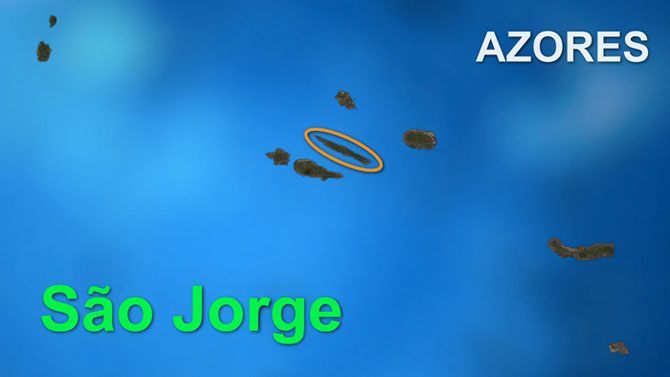
The island of Sao Jorge is part of Azores' central group and lies 21,6 miles off Graciosa, 11 miles off Pico, 32,4 miles off Terceira and 16,2 miles off Faial. It has an approximate area of 95 sq. miles (246 km2). The island has about 9500 inhabitants. The main municipalities are Velas and Calheta.
 
S. Jorge Island has an indented coastline appearing with an oblong shape. A mountain range forms the back-bone of the island and its highest peak, the Pico da Esperanca at 3455 feet (1053 m), offers great views of the other islands of the central group.
 
Sao Jorge is also known as one of the island of the "triangulo" (triangle) which also comprise of Faial and Pico.
Pin It
Tweet
The history and settlement of Sao Jorge is shrouded in mystery. The first reference to Sao Jorge dates from 1439 and it is known that in about 1470, when there were already small groups of settlers on the western and southern coasts, and the settlement at Velas had already been founded, the Flemish nobleman, Wihelm van der Haegen, arrived in S. Jorge where he established a settlement at "Topo". It was there that he was to die, famous for his virtues and with his name already translated as Guilherme da Silveira.
 
S. Jorge must have been settled with people from the north of Portugal and prosperity must have come quickly, since its captaincy was given to Joao Corte Real, captain "donee" of Angra do Heroismo on Terceira island, in 1483, with Velas receiving its town charter by the end of the 15th century. Topo became the seat of a municipality in 1510 and the same happened to Calheta in 1534, demonstrating the vitality of the economy, the mainstays of which were the production of grapes, wheat, woad and lichen. The two latter products were exported to Flanders and other European countries where they were used in dyeing.
 
The dynastic crisis brought about when Philip II of Spain took the Portuguese throne had its repercussions in Sao Jorge which, like Terceira, sided with the pretender Dom Antonio, Prior do Crato. In fact, Sao Jorge capitulated to the Spaniards only after the fall of Terceira in 1583. This was followed by a centuries-long of near isolation, attributed to the precarious shelter that its ports offered to ships and to its limited economic importance. Even so it was subjected to attacks by English and French privateers during the 16th and 17th centuries and devastating raids by Turkish and Algerian corsairs. At the end of the 16th century, a part of the fleet commanded by the Earl of Essex landed at Calheta inlet. To repel the invaders, the inhabitants threw heavy stones, the only weapons possessed. A soldier called Simao Gato rushed at the commanding officer of the enemy force, knocked him down and seized the flag from his hands. In the 16th century the French privateer, Du-Guay-Trouin, pillaged Sao Jorge and in the year 1816 an Algerian pirate, who was trying to take a merchant ship, was driven off by shots fired from the fortress of Calheta. But other calamities also affected Sao Jorge including food shortages, hunger in bad crop years from the 16th to the 19th centuries, as well as earthquakes and volcanic eruptions of 1580, 1757 and 1808.
 
The past isolation of the island was overcome by the works carried out in the two main ports of Velas and Calheta as well as by the building of an airport. These public works have opened new horizons of prosperity and progress for Sao Jorge which is counting on a more efficient use of its natural resources and the expansion of livestock, the dairy industry, fisheries and the canning industry.
Pin It
Tweet
Coordinates: 38°39′N 28°5′W
 
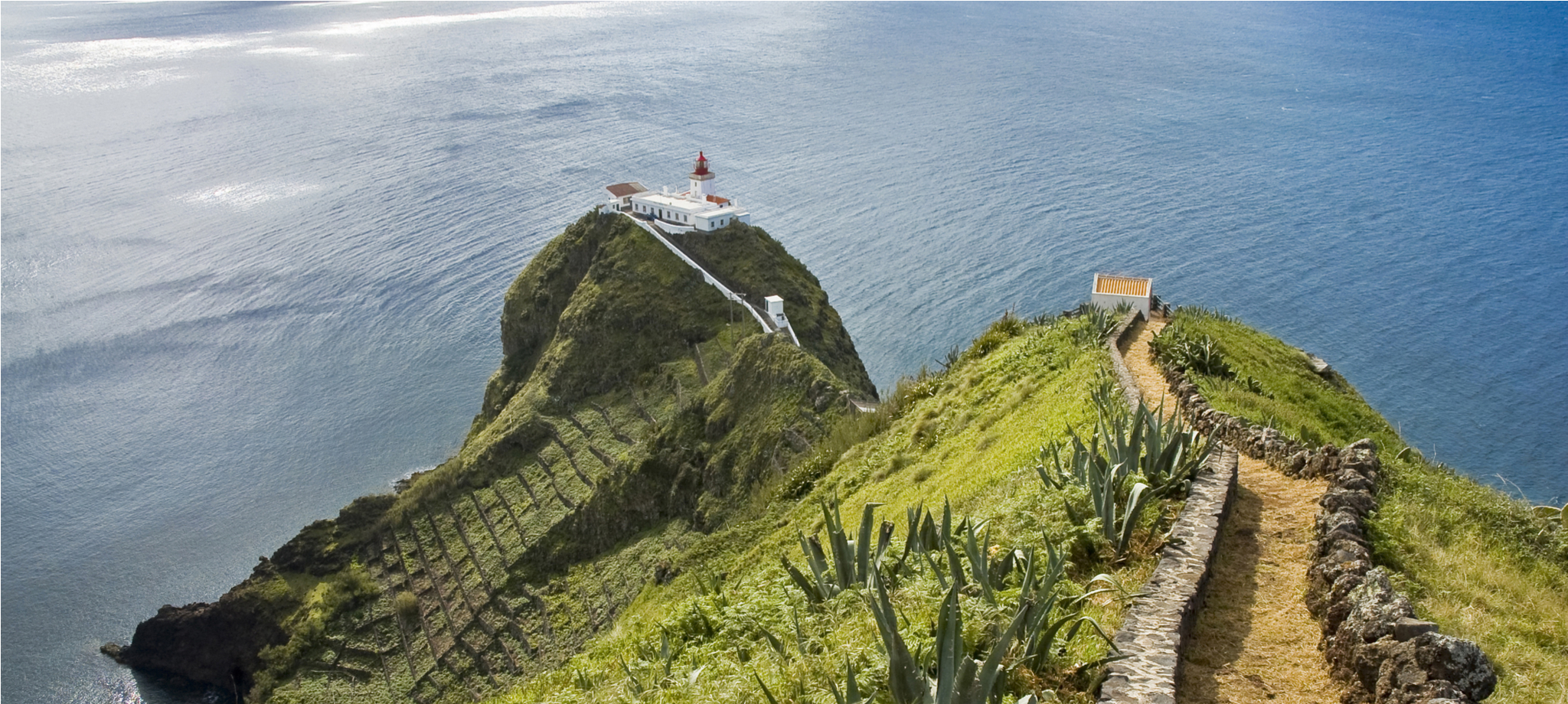
An elongated island with a length of 35 miles (56 km) and a maximum width of only 5 miles (8 km), Sao Jorge has an area of 95 sq. miles (246.25 km2). Created by successive volcanic eruptions in a straight line, of which craters remain, its central platform has an average altitude of 2297 feet (700 m). The coast is steep and almost vertical, particularly in the north, although the cliffs are interrupted by small coastal flat areas: The fajãs.
 
Sao Jorge was built on volcanic fissures associated with the plate tectonics of the mid-Atlantic Ridge and a transform fault that extends to the island of Sao Miguel (referred to as the Sao Jorge Fault). The island was built through successive fissure eruptions, and the only remnants of these forces are the line of volcanic cones that extend along the central ridge with a maximum height of approximately 700 meters.
Pin It
Tweet
After a period of small subsistence agriculture, the local economy began to concentrate on a few chief exports of lichen, woad and later with the introduction of wheat and corn crops. Woad was one of the most important exports from Sao Jorge. It was initially introduced by Willem van der Hagen around 1490, and exported primarily to his countrymen in Flanders. Both woad and lichen were very popular in central Europe as a dye.
 
After 1571, these exports were later overcome by grapes and wine and endured for the next three centuries. The majority of the wine production was located in the area between Queimada, Urzelina and Manadas, with grapes of the "Verdelho" and "Terrantez" castes, as well as some "Bastardo", "Moscatel" and "Alicante" produced in an area that became lucrative and highly prized. Unlike the other islands, where grape vines grew on the rocky hedge-rows or around protective volcanic rocks, the grapes of São Jorge were grown between many of the natural species of bush and trees. Sao Jorge wines were so highly esteemed that the Count of Almada, then Captain General of the Azores, created the "Sao Jorge" brand in order to mitigate fraudulent sales. The wine was also appreciated during the World Exposition of 1867 (in Paris, France) where it rivaled Porto wine. Unfortunately, the Oidium tukeri grape/vine disease reached the island in late 1854 and destroyed the prosperous industry. Various attempts were made to restart the wine industry. Meanwhile the Filoxera disease continue to destroy many of the vineyards in the municipality of Calheta during the second half of the 18th Century, and throughout the island the disease would bring many producers to bankruptcy. The remnants of the viticulture of the island banded together around Casteletes, in Urzelina.
 
Yam is widely popular and cultivated in any plot of land, and was used as an important subsistence food during the islands formative years although never becoming a major export product. It was so important that it was included in the Coat-of-Arms of Calheta, since 1694.
 
Fishing and tourism continue to be an important part of the local economy. Whale watching is one of the most popular activities.
 
While cereals, vineyards and local vegetables are still grown sporadically around the island (much like the other islands of the Azores) the economy of Sao Jorge is currently dependent on the dairy industry.
Pin It
Tweet
The Fajã of the Caldeira do Santo Cristo, is in the Ribeira Seca area and it is a protected nature reserve with an underground cave and a lake.
 
The Topo islet lies on the eastern tip of the island. It is also a natural reserve and a breeding ground gulls of the central group of islands, as well as a home for migratory species of sea-bird.
 
A walk along the sea-shore near Urzelina takes one to the "Furnas da Pombas", a curious volcanic rock formation which is populated by wild pigeons.
 
Urzelina where the tower is all that remains of an ancient church that was buried when the Pico de Esperanca erupted in 1808.
 
Manadas - A picturesque village with attractive country houses surrounded by orchards and cultivated fields.
 
Church of Santa Barbara. Built in the 18th century, in Baroque style with carved archway and chancel with a carved cedar roof, features a valuable collection of hand-painted tiles depicting scenes of the life of Saint Barbara.
Pin It
Tweet
Previous
Next

Activities

Market browsing

Browsing and shopping local outdoor markets is a local pastime

#

Hiking

Lagoa do Congro - The Azores have numerous hiking trails

#

Yoga in the park

Parque Urbano (Ponta Delgada) - Yoga hour.

#

Wind Sports

From paragliding to sailing the Azores is ideal for wind sports

#

Bike riding

The Azores are a bike riding friendly place

#

Hiking and Walking

Hiking and Walking are a local pastime

#

Whale and Dolphin Watching

Cetaceans can be observed in many island of the Azores. You may swim among dolphins if you feel adventurous

#

Bird Watching

The Azores is popular with bird watchers

#
http://www.azores.com/components/com_gk2_photoslide/images/thumbm/534270eunice516.jpg
http://www.azores.com/components/com_gk2_photoslide/images/thumbm/331164hiking516.jpg
http://www.azores.com/components/com_gk2_photoslide/images/thumbm/166721yoga516.jpg
http://www.azores.com/components/com_gk2_photoslide/images/thumbm/405149parapente516.jpg
http://www.azores.com/components/com_gk2_photoslide/images/thumbm/906192biking516.jpg
http://www.azores.com/components/com_gk2_photoslide/images/thumbm/760910walkingurbano516.jpg
http://www.azores.com/components/com_gk2_photoslide/images/thumbm/639887whale516.jpg
http://www.azores.com/components/com_gk2_photoslide/images/thumbm/216558bird516.jpg
News Image

...

News Image

...

News Image

...

News Image

...

News Image

...

News Image

...

News Image

...

News Image

...

Sao Jorge Island is a paradise for sports fisherman and scuba divers interested in underwater observation. In Sao Jorge one will find an enormous number of fish along the coast. To hunters Sao Jorge offers rabbits and pigeons (yes you read it right). But it is the varied landscape, made up of broad views of a succession of verdant levels, fascinating for walkers. Thrilling and exciting scenes of deep ravines (Fajas) disappearing into the sea, geometrical shapes of cones of extinct volcanoes, and colorful hues of wild flowers make Sao Jorge arguably the best trekking island, second only to Sao Miguel.

Events

IRC Rally Azores

S. Miguel island is part of the IRC car rally circuit happening annually

#

Senhor Santo Cristo

Arguably the biggest religious festivities in Azores, happens annually on the fifth weekend after Easter

#

Bull Fights (bull on rope)

People waiting for bull - Typical of Terceira island it happens in many places throughout the island from May to September

#

Limas water battles

Ponta Delgada - Traditional battle of limas happens during carnival

#

Flower street carpets

Traditional flower carpets adorn the way for processions in religious festivities

#

Festival of lights

Convento da Esperanca - One of the highlights of religious festivals are the amazing light displays

#

Street Vendors

Selling the typical tremoco (lupinus) and candy

/__404__

Carousel

Always a hit with young and old carousels are part of the festivities fabric

#
News Image

...

News Image

...

News Image

...

News Image

...

News Image

...

News Image

...

News Image

...

News Image

...

The inhabitants of Sao Jorge hold a colorful and joyful series of events every year. These are the famous Holy Ghost Festivals which date back to the time of the settlers and join the inhabitants together in a fraternal spirit. The festival begins with the crowning of the "emperor". It continues with the displaying of the crown for 8 days in the house of the managers, and ends on the feast day of the "empire", when a copious meal is served while the "jesters" sing old tunes accompanied by drum and cymbals. In the afternoon, bands liven things up with their music. Sometimes "bullfighting on a rope", brought from neighboring Terceira Island, envies the bravest to challenge the animal, not always successfully but in a way that is always lively and cheery. The bullfights are held all over the island, starting with spring and continuing until end of summer.

The Cultural Week event is held in the first week of July in Velas. Calheta celebrates the July festival on the second week of July with music, theatre, expositions, conferences and seminars. National and international artists participate. Sports events also make part of the festivities.

Santo Cristo folk pilgrimage is a merry and rustic festival held in Sao Jorge where fireworks, colorful arches and music provide the framework for the religious ceremony. Santo Cristo is held at “Faja of Santo Cristo” on the first Sunday in September. 

Gastronomy

Sopas Feasts

Traditional Holy Ghost Sopas from Santa Maria

#

Dill & Mint

Dill is specific of Santa Maria. Mint is used in all Sopas

#

Lining up for Sopas

Long lines demonstrate the popularity of Sopas feasts

#

Sopa Bowl

Sopas a tradition shared in every Azorean community

#

Biscoitos (cookies)

Making biscoitos de orelha

#

Sopa plate

The famous sopa plate

#
http://www.azores.com/components/com_gk2_photoslide/images/thumbm/887538smasopas516.jpg
http://www.azores.com/components/com_gk2_photoslide/images/thumbm/310610endrohortela516.jpg
http://www.azores.com/components/com_gk2_photoslide/images/thumbm/583296filasopas516.jpg
http://www.azores.com/components/com_gk2_photoslide/images/thumbm/213040panelasopas516.jpg
http://www.azores.com/components/com_gk2_photoslide/images/thumbm/435103bisoitos516.jpg
http://www.azores.com/components/com_gk2_photoslide/images/thumbm/698132prato516.jpg
News Image

...

News Image

...

News Image

...

News Image

...

News Image

...

News Image

...

The typical meat and fish dishes of the Azorean cuisine are also present in Sao Jorge. However, Sao Jorge has exclusive rights to the fleshy cockles that are caught in the waters of the lake called "Caldeira de Santo Cristo". There is also a large variety of sweets with names such as coscoroes, rosquilhas de aguardente, especies, suspiros, esquecidos, bolo de vespera, cavacas, bolo de coalhada and doce branco.

Sao Jorge is by far best known for it cheese, the famous "Queijo de Sao Jorge". The green grass of the fields is transformed into milk in the udders of the local cows. And from it are produced creamy, straw-colored cheeses that have the size of wheels and weigh from 14 to 22 pounds. Cured for several months in rooms where a constant temperature is maintained, the cheese acquires a honey colored rind. Afterwards, it is exported to various countries, where it is appreciated for the piquant flavor it acquires with time where it makes it a delicious appetizer or dessert.

Handicraft

Clay work

Clay and Wicker are art forms that span centuries in Azores

#

Bonecos

Bonecos are figurines made of straw and cloth

#

Wicker work

Wicker is used for many uses. More traditional for basket weave.

#

Clay artisan

Azores ceramics industry is world renowned

#

Mantle weaving

Santa Maria mantle weaving

#
http://www.azores.com/components/com_gk2_photoslide/images/thumbm/751184barro516.jpg
http://www.azores.com/components/com_gk2_photoslide/images/thumbm/608767bonecos516.jpg
http://www.azores.com/components/com_gk2_photoslide/images/thumbm/990218cestos516.jpg
http://www.azores.com/components/com_gk2_photoslide/images/thumbm/679513barro516.jpg
http://www.azores.com/components/com_gk2_photoslide/images/thumbm/801303ter516.jpg
News Image

...

News Image

...

News Image

...

News Image

...

News Image

...

Sao Jorge crafters are responsible for one of the most characteristic forms of handicraft in the Azores; the home-made quilt with a patchwork of squares and rectangles, in which red and yellow are the prevailing colors, covering the whole cloth. These colorful quilts are laboriously made on crude wooden weaver's loom using secular techniques. Made of warm wool to keep out the cold of winter nights, they add a colorful and cheerful note to the simple, whitewashed walls of the houses on Sao Jorge.

Local Products

Flowers

Azores flowers for all tastes

#

Pineapple of S. Miguel

Pineapples are grown in green houses and are only a product of S. Miguel

#

Meats

In Terceira, for example, cows outnumber people 2:1, thus the abundance of dairy and meat

#

Fish

Fish, abundant and varied, is an essential ingredient in the Azorean diet

#

Cheese - A Specialty

Cheese from S. Miguel, S. Jorge, Faial and Pico are world renowned

#

Vegetables

A variety of vegetables can be found in the Azoes including the local inhame (yam)

#
http://www.azores.com/components/com_gk2_photoslide/images/thumbm/699087flores516.jpg
http://www.azores.com/components/com_gk2_photoslide/images/thumbm/270478ananas516.jpg
http://www.azores.com/components/com_gk2_photoslide/images/thumbm/703127meat516.jpg
http://www.azores.com/components/com_gk2_photoslide/images/thumbm/897051fish516.jpg
http://www.azores.com/components/com_gk2_photoslide/images/thumbm/634177queijo516.jpg
http://www.azores.com/components/com_gk2_photoslide/images/thumbm/715643legumes516.jpg
News Image

...

News Image

...

News Image

...

News Image

...

News Image

...

News Image

...

São Jorge is known for its cheese and colorful quilts.

Pin It
Tweet
  Ads - Why these?

about us | contact us | travel agents | advertise with us | privacy statement | terms and conditions | testimonials | sitemap

Copyright © 1996 - 2013 Portugal Online - All Rights Reserved | Custom Design by 1ms.pt
 Top