Discover Azores | Azores.com

           Login | Register 


Password? | Username?

Close

*
*
*
*
*

Fields marked with an asterisk (*) are required.

Close
| Share : |
English PortuguêsDeutsch - Bitte beachten Sie, dass es keine deutscEspañol - Atención, los módulos de travel no están

5_disc

Get our Quarterly Newsletter
Lastest news and specials
Reset

     Azores Travel & Tours
     Online since 1996

    AirAirAir FerryFerryFerry HotelHotelHotel CarCarCar ToursToursTours FunFunFun FoodFoodFood ContactsContactsContacts

Discover

AzoresAzoresAzores
Santa MariaSanta MariaSanta Maria
São MiguelSão MiguelSão Miguel
TerceiraTerceiraTerceira
GraciosaGraciosaGraciosa
São JorgeSão JorgeSão Jorge
PicoPicoPico
FaialFaialFaial
FloresFloresFlores
CorvoCorvoCorvo
Real EstateReal EstateReal Estate
Maps & POISMaps & POISMaps & POIS

Restaurants

Azores Restaurants

Like us!

FacebookNew

Events Calendar

<< May 2013 >> 
 Mo  Tu  We  Th  Fr  Sa  Su 
    1  2  3  4  5
  6  7  8  9101112
13141516171819
20212223242526
2728293031  
You are here : Terceira

  • About
  • Activities
  • Events
  • Gastronomy
  • Handicraft
  • Local Products

About

Poster Image

Download Video: MP4, HTML5 Video Player by VideoJS

  • The Island

  • History

  • Geography

  • Economy

  • Points of Interest

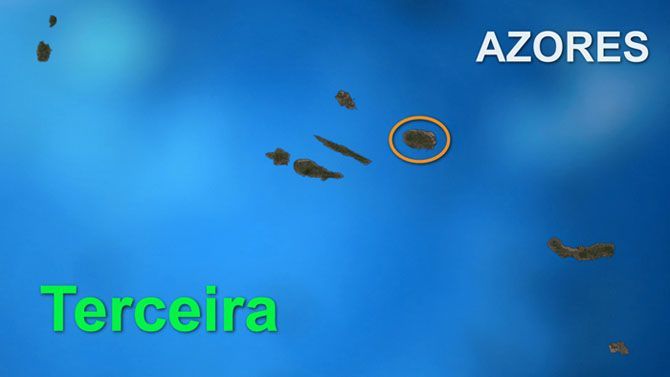
Terceira Island (the "lilac"island) is located approximately 90 miles off Sao Miguel and 66 miles off Faial, and has a surface area of 148 sq. miles (382 km2). The international airport, located in "Lajes", about 2 miles from the city of "Praia da Vitoria", serves both civilian and military needs, and includes both the Military Command for the Azores as well as an important American Air Force Base located in Lajes. Terceira is the second most populated Azorean island with 58000 inhabitants and the third biggest in surface are after S. Miguel and Pico.
 
Terceira's municipal seat is located in "Angra do Heroismo", where the The Paços do Concelho" (City Hall), a majestic construction of the 19th century, is an important example of the rich architectural patrimony of Angra.
 
After a violent earthquake in 1980, and the subsequent reconstruction of the city, a large portion of Angra's historical center has been classified of "public interest", and is included in the UNESCO's list of World Patrimony since 1986. Angra do Heroismo also features one of the best public libraries and archives in Portugal and also retains some important private art collections.
 
The network of streets of a town that is a monument in itself; The colorful "impérios" or chapels that bear witness to the popular devotion of the Holy Spirit; The walls of a castle that was a royal prison; The constant presence of history; The gentle undulations of a green countryside; The white triangle of the typical chimneys; All features of the attractive and colorful prism that is Terceira.
terceira670
Pin It
Tweet
Terceira was known as the island of Jesus Christ as it was settled by Portuguese navigators. Terceira's settlement was started on or about 1450 when its captaincy was granted to a Flaming, Jacome de Bruges, by Prince Henry the Navigator. The first settlements were situated in the areas of Porto Judeu and Praia da Vitoria and soon extended throughout the island.
 
Initially, Terceira's economy revolved around agriculture mainly through the production of grains, and the export of woad (a dye-yielding plant). Terceira began to play an important part in the history of navigation during the 15th and 16th centuries, as a port of call for the galleons bringing the wealth of the Americas and the ships engaged in the India trade. During this period Terceira was an emporium for the gold, silver, diamonds, and spices brought from other continents, which attracted the covetousness of French, English and Flemish corsairs who constantly attacked its coast for several centuries.
 
When Philip II of Spain took the Portuguese throne in 1580, Terceira supported the claims of the Portuguese pretender, Dom Antonio, Crato's Prior, who even came to reside on the island and, among other things, to coin money, which led to Spanish attempts to defeat him. The first landing by Spanish troops in 1581, was completely rebutted in the famous battle of "Salga", where the writers Cervantes and Lopo de Vega took part. In 1583 a much larger Spanish armada commanded by Don Alvaro de Bazan, the victor of the battle of Lepanto, managed to dominate the island after violent fighting.
 
Terceira Island was a port of call for the Spanish galleons filled with the fabulous wealth of Peru and Mexico until about 1640. With the Restoration of Portugal's independence, line Spaniards were expelled and life returned to normal. Terceira kept its position as the economic, administrative and religious centre of the Azores until the early 19th century. The struggles that accompanied the introduction of liberalism led Terceira to play an important role in the history of Portugal once again. The island supported the liberal cause as from 1820. After various vicissitudes, a turn of events in 1828 led to absolutist's concession in Terceira thus becoming the main base for the liberals. An absolutist attempt to land at Vila da Praia was defeated in 1829, and event that was followed by the establishment of a liberal regency in Terceira and the later conquest of the other islands of the archipelago by the constitutional forces. In 1832, it was from Terceira that the liberal expedition left for the landing at "Mindelo" in northern Portugal and the subsequent proclamation of the Constitutional Charter.
 
The end of the l9th and the beginning of the 20th century were marked by a progressive reduction of Terceira's role in the life of the Azores. However, the construction of the commercial port at Praia da Vitoria, the presence of an important air base with a subsequent agreement and leasing of a large area of the air base to the United States and the improvement of a international airport have opened up Terceira to new development perspectives. An interesting fact revolves around the date of March 16th 2003 when then President of the United States George W. Bush, UK Prime Minister Tony Blair, Spanish Prime Minister Jose Maria Aznar and Prime Minister of Portugal Jose Manuel Barroso met on Terceira's Lajes air base to discuss the Invasion of Iraq, which began four days later, on 20 March.
Pin It
Tweet
Terceira Coordinates: 38° 43′ 20″ N 27° 12′ 25″ W
 
Terceira volcanic complexion results from overlapping strato-volcanoes built over a geologic line called the Terceira Rift. These volcanic areas include the "Cinco picos", "Guilherme Moniz", " Pico Alto" and "Santa Barbara" volcanic aggregates.
 
The western part of Terceira Island has more vegetation than the eastern part, due to the prevailing westerly winds and increased precipitation. Other geographical areas of interest include the plains of " Achada", the hills near "Santa Barbara", the small lagoon of "Lagoa das Patas".
 
The northern coast is an area marked by evidence of volcanic activity with several "misterios" (lava fields) and the swimming pools of Biscoitos. The center of the island features the dormant volcanic caves of "Algar do Carvao" a popular fixture with tourists.
Pin It
Tweet
Terceira's main economic activity is rising of livestock and the production of dairy-based products. Terceira has two main sea ports, one at Angra do Heroismo and the other at Praia da Vitoria, and a commercial airport integrated with the flight operations of the air force in Lajes. Terceira's economy also benefits greatly from the leasing agreement for the air force base with the United States which brings a tremendous amount of indirect revenues to the its population.
Pin It
Tweet
"Monte Brasil", classified as national protected landscape, provides a recreational area, hiking trail, and resting place as well as a fantastic view over the ocean and the city.
 
The " Sao Joao Baptista do Monte Brasil" fort, is a large, fortified wall 2.5 miles long.
 
The Angra do Heroismo Museum, is located in the old Convent of St. Francis and is adjoined to the "Nossa Senhora da Guia" Church (Our Lady of Guidance).
 
The "Imperios"(religious monuments) are all over the island and are considered interesting due to their colorful facade
 
The "Algar do Carvao" is famous for its' grottoes that reach a depth of approximately 328 feet (100 meters). These spectacular grottoes contain stalactites, stalagmites and an interior lake. Near the "Algar" the "Enxofre" and "Cabrito" caves and the "Balcoes" and "Natal" grottoes, are of special interest especially to scientists.
 
"Praia da Vitoria" is a young town with the best and most inviting beach in Terceira. The architectonic patrimony is concentrated in the churches and chapels.
 
"Biscoitos" where you can visit the only wine museum in the Azores archipelago. The museum, inaugurated in 1990, illustrates the process of traditional wine making in the archipelago.
Pin It
Tweet
Previous
Next

Activities

Market browsing

Browsing and shopping local outdoor markets is a local pastime

#

Hiking

Lagoa do Congro - The Azores have numerous hiking trails

#

Yoga in the park

Parque Urbano (Ponta Delgada) - Yoga hour.

#

Wind Sports

From paragliding to sailing the Azores is ideal for wind sports

#

Bike riding

The Azores are a bike riding friendly place

#

Hiking and Walking

Hiking and Walking are a local pastime

#

Whale and Dolphin Watching

Cetaceans can be observed in many island of the Azores. You may swim among dolphins if you feel adventurous

#

Bird Watching

The Azores is popular with bird watchers

#
http://www.azores.com/components/com_gk2_photoslide/images/thumbm/534270eunice516.jpg
http://www.azores.com/components/com_gk2_photoslide/images/thumbm/331164hiking516.jpg
http://www.azores.com/components/com_gk2_photoslide/images/thumbm/166721yoga516.jpg
http://www.azores.com/components/com_gk2_photoslide/images/thumbm/405149parapente516.jpg
http://www.azores.com/components/com_gk2_photoslide/images/thumbm/906192biking516.jpg
http://www.azores.com/components/com_gk2_photoslide/images/thumbm/760910walkingurbano516.jpg
http://www.azores.com/components/com_gk2_photoslide/images/thumbm/639887whale516.jpg
http://www.azores.com/components/com_gk2_photoslide/images/thumbm/216558bird516.jpg
News Image

...

News Image

...

News Image

...

News Image

...

News Image

...

News Image

...

News Image

...

News Image

...

Terceira’s 18-hole golf course spread over the gentle hills next to Algar do Carvao a must stop landmark. Angra do Heroismo and Praia da Vitoria offer excellent conditions for the practice of sailing, windsurfing and water skiing. Grottoes set in the bowels of the Earth stimulate the curiosity of speleologists. Green fields invite visitors to take restful walks through pastures and flowers. Those who are more keen on sports will find a climb up the Serra de Santa Barbara and Pico Alto to be a way to broaden their horizons and be thrilled by a landscape made up of numberless hues of green, framed by the blue of the sea and sky. Catch a combative fish from rocks or from a boat rocked by the waves. Walk over hills and dales in pursuit of elusive rabbits. These are some of the pleasures that Terceira offers for lively active holidays.

The sea and fishing

Set in the middle of a sea that is rich in fish, Terceira offers the rock fisherman a chance to catch the conger eel, Jack Grevalle, mackerel, snapper bream, moray eel and broadbill sword fish, The best fishing grounds are situated in the areas of Angra de Heroismo, Sliveira, São Maleus, Pesqueiro, Biscoitos, Praia da Vitoria, Porto Martins, Porto Novo and Porto Judeu.

Discovering Nature

Terceira entices the discovery of different views at every step, the appreciation of the charms of a path winding through pastures, the liquid water-color formed by the sea as seen from the top of a cliff or white houses surrounded by flowers. This is the attraction of Terceira, the discovery that is not included in tourist guide-books.

Some of the best walks and treks include Monte Brasil, a protected natural park in Angra do Heroismo with some of the most beautiful sceneries seen in Terceira. The hydrangea covered road running along the hillside of Serra of Santa Barbara offers breathtaking views. While there one can pay a visit to Santa Barbara caldeira.

Check out the abundant vegetation of forest of Serreta and the vista point of Peneiroa. The Caldeira of Guilherme Moniz with a perimeter of 14 Km (roughly 9 miles) is a must see.

The natural reserve of Algar do Carvão features caverns full of stalactites and stalagmites 100 meters deep which lead to a subterranean lake. Nearby visit the sulfur caverns, Agulhas and many more.

In Terceira’s Serra do Cume one can admire the scenery overlooking Praia da Vitoria. Ilheu das Cabras, an important and protected breeding ground for a variety of bird species can be admired as one passes through the south coast of Terceira.

Some other lakes worth the walk are Pico do Boi, Lagoa das Patas and Lagoa do Negro. The Alagoas (little lakes) features a protected area with rich endemic vegetation.

Stop at Biscoitos with its lava formations, home of vineyards and ocean natural pools.

Pico Alto is the most challenging hike with a rewarding panoramic view. Other hikes can be had at Picos da Bagacinha and Cabrito.

Events

IRC Rally Azores

S. Miguel island is part of the IRC car rally circuit happening annually

#

Senhor Santo Cristo

Arguably the biggest religious festivities in Azores, happens annually on the fifth weekend after Easter

#

Bull Fights (bull on rope)

People waiting for bull - Typical of Terceira island it happens in many places throughout the island from May to September

#

Limas water battles

Ponta Delgada - Traditional battle of limas happens during carnival

#

Flower street carpets

Traditional flower carpets adorn the way for processions in religious festivities

#

Festival of lights

Convento da Esperanca - One of the highlights of religious festivals are the amazing light displays

#

Street Vendors

Selling the typical tremoco (lupinus) and candy

/__404__

Carousel

Always a hit with young and old carousels are part of the festivities fabric

#
News Image

...

News Image

...

News Image

...

News Image

...

News Image

...

News Image

...

News Image

...

News Image

...

Sanjoaninas
From 21.06.2013 Until 29.06.2013
Culture Terceira Sanjoaninas
Festas da Praia
From 03.08.2013 Until 11.08.2013
Music Praia da Vitória Festas da Praia

Besides the various pilgrimages, the picturesque ranchos dos Reis or groups who travel over the parishes singing Christmas carols, and the lively Carnival dances, the Festivals of the Holy Ghost are the events that best express the feelings of the people of Terceira.

Holy Ghost Festivals - all over Terceira island

Linked to Franciscan mysticism and the charitable spirit of Queen St. Elizabeth of Portugal (16th century), the Festivals of the Holy Ghost came to the Azores with the first settlers. The invocation of the Holy Ghost at the time of the natural catastrophes that struck the archipelago, and the fame of the consequent miracles together with the hard life and isolation of the islands, all contributed to making the devotion sink deep roots and persist in the Azores, while disappearing in Portugal with rare exceptions. Moreover, Azorean emigrants carried the devotion to Brazil, America and Africa, where the old ceremonies are now repeated in all traditional splendor. The Holy Ghost Festivals are also held in Hawaii, where there is a large Azorean community.

Of a charitable nature, the festivals are aimed at distributing food to the needy. Everything starts on Trinity Sunday with the drawing of the names among the "brothers" to determine who will be the “mordomos” or stewards of the festival in the following year.

The first to be chosen keeps the insignia of the Holy Ghost (crown and scepter on a silver plate) in his house until Low Sunday, when the festivities begin with ” balhos” or dances accompanied by guitars and singing while the "throne" of the Holy Ghost is set up and profusely decorated in the "stateroom", the main apartment of the house. The "coronation" ceremony is then held in the parish church, the crown is placed on the head of a child or adult called the "emperor" who carries in procession the symbols of his dignity to the house of another steward in a ceremony called "disposing of the crown" where it is kept for a week. Afterwards, on every Sunday, the crown, scepter and plate are passed on to the houses of the other stewards until the feast day itself, when they are displayed in the “Imperio” (literally, empire) or chapel.

On that day the beef, offered to fulfill promises, is made into the typical "Holy Ghost soups" and the fragrant “Alcatra” (meat dish) accompanied by various types of bread and “massa sovada” (sweet bread made from kneaded dough). The aromatic red wine called “vinho de cheiro” is consumed by all the inhabitants of the parish and its visitors, in an atmosphere of great rejoicing. The festivals are never lacking in “foliões” or jesters, who are entrusted with the task of announcing, directing and animating the ceremonies with singing accompanied by music on a drum and cymbals, called “testos”. In rural parishes the festival ends with a lively and colorful “tourada a corda” (bullfight on a rope). The Festivals of the Holy Ghost extend from early spring to the end of the summer, spreading joy all over the island.

The St. John's Festivals or "City's Festival"

This Terceira “Festa” is connected to the traditions of the so-called Popular Saints - St. Anthony, St. John and St. Peter. With the passage of the years these festivals have been turned into bullfighting events, with lively "bullfights on ropes", where bulls tethered at the end of a rope roam the streets and performances by “toreadors” on horse and by foot, are center stage in the arena. The St. John's Festivals usually include an ethnographic procession with old farm folk costumes and the typical vehicles called “carros de toldo”.

The festivals last for several days around St. John's Day (24th of June). They are held in the city of Angra do Heroismo.

Touradas a Corda (Bullfighting on a Rope) – Held all over Terceira Island

The bullfighting tradition on Terceira goes back to the 16th century, due to the abundance of cattle, which at that time was over 100,000 head, according to the chroniclers, and the fact that the first settlers came from provinces where bullfighting was deep-rooted.

Added to that was the later Castilian presence and influence in the 17th century. Terceira bullfights developed along the centuries a unique technique perfectly adapted to the local conditions the skill of the bullfighters and the tastes of the population; the always merry and lively "bullfighting on a rope”. In this modality the movements of the bull are conditioned by a rope held by a group of men, formerly called “mascarados da corda” (masked men of the rope). The bulls, bred in the pastures of Terceiras’ central region, are chosen for their ability to follow figures and be cunning. The bull, with its horns padded, is then let loose on the streets of the parish, the windows and balconies of which are crowded with people eager to cheer the spectacle. Fireworks are set and men and bull immediately start running about, with steps that are sometimes luckier than others. "Parasol lucky" is the colorful name that has been given to the maneuvers that have been devised. It consists of putting the parasol (usually red) suddenly in front of the bull and trying to avoid his horns in the subsequent charge, while the men on the rope moderate its momentum. Their job is to not be dragged along while deliberately giving the bull a little more freedom to liven up the show. "Bullfighting on a Rope" has evolved with the passing of time and now held in locations such as near the ocean, on beaches and shallows where boats are run upon for repairs. In it, everyone, including the bull, takes repeated baths in salt water in the midst of the laughs, shouts and hisses of the spectators. Bullfights are held every day somewhere in Terceira between May 1st and September 30th. 

Gastronomy

Sopas Feasts

Traditional Holy Ghost Sopas from Santa Maria

#

Dill & Mint

Dill is specific of Santa Maria. Mint is used in all Sopas

#

Lining up for Sopas

Long lines demonstrate the popularity of Sopas feasts

#

Sopa Bowl

Sopas a tradition shared in every Azorean community

#

Biscoitos (cookies)

Making biscoitos de orelha

#

Sopa plate

The famous sopa plate

#
http://www.azores.com/components/com_gk2_photoslide/images/thumbm/887538smasopas516.jpg
http://www.azores.com/components/com_gk2_photoslide/images/thumbm/310610endrohortela516.jpg
http://www.azores.com/components/com_gk2_photoslide/images/thumbm/583296filasopas516.jpg
http://www.azores.com/components/com_gk2_photoslide/images/thumbm/213040panelasopas516.jpg
http://www.azores.com/components/com_gk2_photoslide/images/thumbm/435103bisoitos516.jpg
http://www.azores.com/components/com_gk2_photoslide/images/thumbm/698132prato516.jpg
News Image

...

News Image

...

News Image

...

News Image

...

News Image

...

News Image

...

A trading center frequented for centuries by galleons and other ships from exotic lands, Terceira Island saw its food lose its initial originality during the 16th and 17th centuries. Over the years other influences added to the present richness and refinement of the island's gastronomy. These influences ranged from the presence of Spanish troops for nearly 80 years, the refugees of absolutism and the Englishmen connected with the "orange trade", to the convent recipes for sweets and liqueurs. The meat specialties called Holy Ghost soups, alcatra and cozido, as well as the locally made wine known as "vinho de cheiro", are connected with the festivities that animate the whole island in the summer. Having a place in the festivals is also "massa sovada" (sweet bread), baked into biscuits of various shapes including some with the forms of animals and humans. Other delicious dishes are "caldeirada" (fish stew) with apples, sarapatel (haggis) and morcela (a kind of blood sausage) as well as the various traditional recipes for octopus, rabbit (with a special sauce called molho de vilão), crabs, goose barnacles and limpets.

But cooking in Terceira reaches perfection in the form of the over two hundred recipes for sweets. Most of these sweet-meats, such as donas-amelias and coscoroes, are made in accordance with convent traditions. Fresh cheeses made from goat's milk and the “Ilha” cheese made from cow's milk put a fine finish to any meal. As far as wine, Porto Martins and Pesqueiro produce a "verdelho" while the wine of Biscoitos enjoys great local fame. The local liquor “Angelica” is also a Terceira native.

Confections

Sugar paste, mixed with water and a drop of vinegar, is transformed by the skilled hands of women confectioners into flowers, doves, chickens, swans, rabbits and calves - a varied, sweet and fantastic world of sugar. These sweet-meats are associated with the Festivals of the Holy Ghost and those of the patron saints, and are often used as thanks for miracles obtained. In the latter case the confection takes the shape of the part of the human body that has been cured (a breast, arm, leg, etc.). The sweet-meats are long-lasting and therefore, when not consumed by visitors with a sweet tooth, make an original souvenir of Terceira.

Sweet potatoes

The mild climate of the Azores and its position as a port of call from the 15th to the 17th centuries enabled Terceira to add to the traditional European crops of the time new plants brought from other continents. This led to the fact that early in the 16th century, before it was introduced in Europe, the sweet potato was being planted in Terceira, whence it spread to the other islands. For the same reasons maize, yams and potatoes have been part of the diet of Azoreans from those early times. 

Handicraft

Clay work

Clay and Wicker are art forms that span centuries in Azores

#

Bonecos

Bonecos are figurines made of straw and cloth

#

Wicker work

Wicker is used for many uses. More traditional for basket weave.

#

Clay artisan

Azores ceramics industry is world renowned

#

Mantle weaving

Santa Maria mantle weaving

#
http://www.azores.com/components/com_gk2_photoslide/images/thumbm/751184barro516.jpg
http://www.azores.com/components/com_gk2_photoslide/images/thumbm/608767bonecos516.jpg
http://www.azores.com/components/com_gk2_photoslide/images/thumbm/990218cestos516.jpg
http://www.azores.com/components/com_gk2_photoslide/images/thumbm/679513barro516.jpg
http://www.azores.com/components/com_gk2_photoslide/images/thumbm/801303ter516.jpg
News Image

...

News Image

...

News Image

...

News Image

...

News Image

...

In Terceira, Feminine hands embroider linen with traditional motifs where blue and green flower themes predominate. They also make dainty lace, artificial flowers and the typical caps worn by shepherds. The men, on the other hand, account for the wickerwork, pottery, objects of daily use made from the island's cedar wood, ornaments made from animal horns, tin articles, colorful slippers, practical galoshes and the guitars that are heard on feast days.

The counterpanes made on looms

The weaving tradition on Terceira dates back to the settlement period, when families depended on home-made woolen and linen cloth to make their own clothing. The heavy old looms are still used to make woolen counterpanes in many colors and with geometrical designs. These counterpanes are used all over the island to cover beds and also to decorate windows on festive occasions.

The "Empires" of the Holy Ghost

All over Terceira one finds the colorful chapels known as "imperios" (empires) or “teatros” (theatres) of the Holy Ghost, with their detailed decorations and fantastic shapes, contrasting with the whiteness of Terceira's villages. "imperios" are one of the most original, traditional and interesting forms of Azorean popular architecture and of the peculiarities of the local way of life and state of mind.

There are about 50 "imperios" spread all over the island. Most of these "imperios" date from the 19th century when they replaced the original ones part of which, it is thought, were wooden affairs that could be put together and taken apart. Annexed to the "imperios" are the "larders", where the bread, meat and wine to be used in the festivals is kept; some of them have allegorical decorations.

At the top of their facades the "imperios" have a white dove or crown. The windows are large, usually with wrought iron gratings. Inside is the altar, with its niche where the crown and plate are placed, and the tables used by the members of the Brotherhood to receive alms and offer food and wine to anyone they decide to grace.

The houses with their curious chimneys

The fact that most of the settlers of Terceira came from the Alentejo and Algarve in southern Portugal is revealed by the rural houses with their white walls and colored edgings along the doors, windows and corners. Made up of dressed stones forming a rectangular parallelepiped which ends in a wedge, the chimneys are called "mão-postas" (hands in prayer) by the people. To prevent rain from entering, many have a canopy part made of bricks or tiles. Typical, too, are the aprons of dressed stone; rounded or of straight lines, they come down from the window sill and end in a fleur-de-lis, point or rosette.

Every house in Terceira has a surrounding garden and next to it is the "burra de milho" where the ears of maize are kept when they are not simply hung from the branches of trees. This offers a unique and unexpected sight. 

Local Products

Flowers

Azores flowers for all tastes

#

Pineapple of S. Miguel

Pineapples are grown in green houses and are only a product of S. Miguel

#

Meats

In Terceira, for example, cows outnumber people 2:1, thus the abundance of dairy and meat

#

Fish

Fish, abundant and varied, is an essential ingredient in the Azorean diet

#

Cheese - A Specialty

Cheese from S. Miguel, S. Jorge, Faial and Pico are world renowned

#

Vegetables

A variety of vegetables can be found in the Azoes including the local inhame (yam)

#
http://www.azores.com/components/com_gk2_photoslide/images/thumbm/699087flores516.jpg
http://www.azores.com/components/com_gk2_photoslide/images/thumbm/270478ananas516.jpg
http://www.azores.com/components/com_gk2_photoslide/images/thumbm/703127meat516.jpg
http://www.azores.com/components/com_gk2_photoslide/images/thumbm/897051fish516.jpg
http://www.azores.com/components/com_gk2_photoslide/images/thumbm/634177queijo516.jpg
http://www.azores.com/components/com_gk2_photoslide/images/thumbm/715643legumes516.jpg
News Image

...

News Image

...

News Image

...

News Image

...

News Image

...

News Image

...

Terceira local products revolve around confections and embroidery.

Pin It
Tweet
  Ads - Why these?

about us | contact us | travel agents | advertise with us | privacy statement | terms and conditions | testimonials | sitemap

Copyright © 1996 - 2013 Portugal Online - All Rights Reserved | Custom Design by 1ms.pt
 Top